
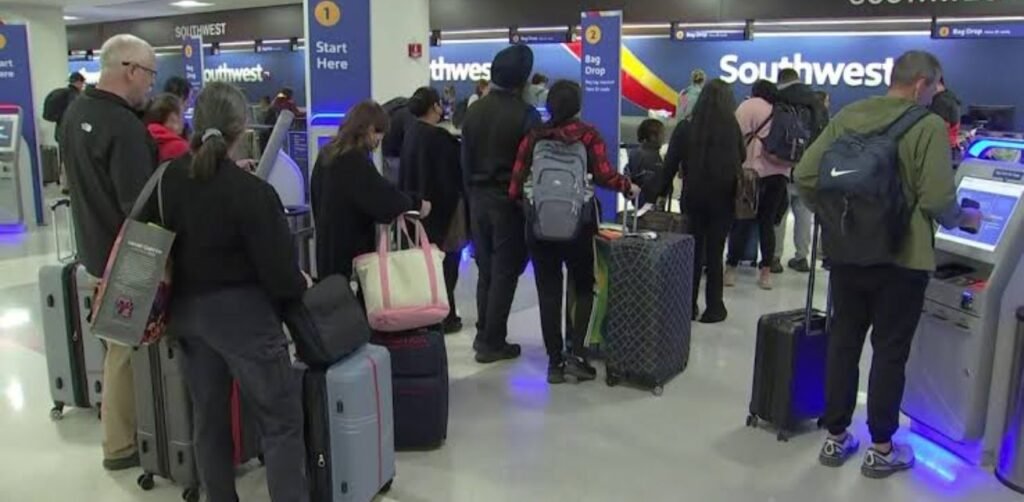
Southwest Airlines is a popular, well-recognized low-cost carrier. It began flying in 1971 from Dallas, marking the start of reliable, friendly, low-cost travel. Its vision is to become the most efficient, most loved airline.
Now, on the topic, Southwest Airlines’ baggage policy is flexible and easy to understand. Read on to learn more about their checked and carry-on baggage allowance, plus personal items and more, for a clearer insight.
What Is Southwest’s Checked Baggage Policy?
Southwest offers different options for checking your bags, including online and at self-service kiosks. You can also check your bags at the self-service kiosks. If you need additional help, a Southwest agent can check your bags at the airport ticket counter. If checking your bags at the airport, ensure that you use a physical credit card to pay any overweight or oversized fees (if applicable). You can track your checked bags in the Southwest app or on their official website.
The standard dimension is 62 inches, including height, length, and width. It includes handles and wheels. Each bag’s overall weight shouldn’t exceed 50 lbs.
Some countries impose baggage embargoes that restrict extra checked bags, alongside oversized and overweight bags. Some destinations apply restrictions year-round, while others apply them only during the holiday season and summer break. For example, flights to Cuba have restrictions year-round. So, you cannot check more than two bags, and bags exceeding 50 lbs and 62 inches aren’t accepted onboard.
Checked and carry-on bag charges depend on your fare type. For Basic, Choice, and Choice Preferred Fares, the first and the second checked bags come for $35 and $45, respectively. Carry-on and personal items are free. For Choice Extra Fare, the first and second checked bags, plus personal items and carry-ons, are free. For detailed information on fees, check Southwest’s official website.
How Much Carry-On Is Allowed On A Southwest Airlines Flight?
Southwest also has a clear, transparent carry-on baggage policy. You can bring personal, item and carry-on (one each)
Carry-on dimensions shouldn’t exceed 24 inches, 16 inches, and 10 inches (length, width, and height). This includes handles and wheels. The item must also fit in the overhead bin. Carry-on examples include a suitcase and a roller bag.
You must be able to store personal items below the seat in front of you. Some examples of personal items include:
- Purse (as well as crossbody bags)
- Backpack
- Laptop case
- Briefcase
- Pillow
- Backpack
- Small camera
- Blanket
If your bag is more than the specified carry-on size, or if you carry more than one personal item or carry-on, they won’t allow them on the plane. Check your bags at the counter before going to the departure gate.
If you have a pet carrier, it will count as either a carry-on or a personal item.
Southwest Airlines’ Rule for Sports Equipment
Southwest allows sports equipment onboard, but the rules vary by item. Check the table to learn more:
| Name of the sports equipment | What they include | Rules and regulations |
| Archery equipment | Bows, arrows, average-sized target; target stands aren’t allowed | Place bows and arrows in a sturdy container to prevent damage. If their weight and / dimension exceeds 100 pounds and 115 inches, they aren’t accepted as checked baggage; overweight and the regular checked baggage fee apply, but oversized charges are waived |
| Softball and baseball equipment | A bat, a helmet, a uniform, a glove, bats (four), batting gloves (one pair), cleats (one pair); a catcher might have extra equipment | Overweight and standard carry-on bag fees will apply, and oversized bag charges are waived |
| Fencing equipment | Foils are permitted only in your checked bags | – |
| Bicycles | Non-motorized bicycles having a single seat should go in as checked bags | Remove handlebars and pedals; also pack them well in protective materials to avoid any damage |
| Kayaks | All kayaks except sea kayaks go in as checked baggage | Secure the paddles well |
| Golf clubs | Includes a golf bag with balls, shoes, and clubs (they’ll go in as checked baggage) | Hooded golf bags or those in a soft-sided case are allowed, provided there’s a limited liability waiver. |
| Scuba equipment | They’ll go in as checked bags; includes a snorkel, two fins, a mask, a safety vest, a knife, a tank pressure gauge, a tank harness, a regulator. | Empty the compressed air; Limited release of liability is required if: The scuba equipment is packaged in plastic bags You are transporting compressed air cylinders |
| Javelins | They’ll be transported in one bag, regardless of how many you carry together. | You need a liability waiver to transport javelins. |
| Lift rafts | They will go in as checked bags | Cartridges (linked with self-inflating life raft should be removed and can’t be carried on board) |
| Water ski equipment | Water skis (one pair), vest/life preserver (one) | Use a hard plastic case to pack it. |
| Snow ski equipment | Snowboard/skis, ski poles, and ski boots go in checked baggage; | No more than two bags are allowed |
| Tennis equipment | A bag with a single tennis racquet and balls will go in as checked baggage | You should use a sturdy container to pack them well |
| Windsurfing boarding | You can carry them as checked baggage | Remove the keel, sail, and boom, and keep them in your checked bags to prevent other baggage from getting damaged. If the windsurfing equipment exceeds 100 pounds, you can no longer carry it as checked baggage |
| To learn more about other sports equipment and the rules for carrying it as checked or carry-on baggage, check Southwest’s official website. For improperly packed goods, you enter into the limit release of liability contract. This means Southwest will not be responsible for any damage. | ||
Southwest Airlines’ Rules for Carrying Musical Instruments
If your instrument meets the carry-on dimension limit, you may bring it onboard, but space availability may limit how many you can bring. If it doesn’t meet the size limit, you can still bring it onboard if it fits in an overhead bin or under the seat.
If you want more overhead space, we recommend buying Priority Boarding. You can also buy a fare with boarding benefits, such as Choice Preferred or Choice Extra.
Standard fees apply when you check your musical instrument. Oversized fees are waived. Overweight fees apply if the weight is 51-165 pounds (case and covering included).
Instruments exceeding 150 inches and/or 165 pounds, including case/cover, won’t be accepted onboard. If you transport your instrument in a soft-sided case or do not pack it properly, Southwest won’t be liable for any damage caused during baggage handling.
If your instrument is too large to fit in the bin or between your legs, then you may buy a non-refundable seat.
- The instrument should fit in the seat you purchase and must be safely tied with a seat belt.
- The instrument shouldn’t block the aircraft signage.
- Place your instrument by the window seat. Occupy the seat next to it.
- You cannot place your instrument in the emergency exit rows.
- To book both your seats, contact the Southwest team. If your preferred seats aren’t available on the flight you desire, the team will assist in booking the next available flight.
- Some instruments, like cello and bass, cannot be secured with a seat belt. Hence, you must check them.
Restricted and Forbidden Items on Southwest Airlines
Southwest Airlines restricts and prohibits some items. You can carry only a few as cabin baggage, whereas some are allowed as checked items. Some are neither permitted in checked bags nor in carry-ons. Let us take a look at a few of them.
- Hazardous materials like fireworks, aerosols, paints, flammable liquids, and more aren’t allowed in checked or carry-on bags.
- You cannot bring e-cigarettes, power banks, vaporizers, and external chargers in your checked bags.
- If you have PEDs (portable electronic devices) like smart phones, tablets, and laptops, they will go in your carry-on. If you cannot take them in your cabin baggage, you have to turn all your devices off to protect them from damage and activation.
Check TSA’s lists and your airline’s rules to know what you can bring and what you should avoid.
Southwest’s Rule For Delayed, Lost, or Damaged Baggage
Southwest does its best to ensure your luggage reaches you on time. However, if your baggage is damaged, delayed, or lost, here is what you must do:
For delayed baggage, file a report immediately at the baggage service office. There’s also signage outside the baggage service office. You will come across a QR code that you can use for scanning and filing a report. However, if you’ve already left the airport, you must file a report online.
If you have a domestic flight, you must notify Southwest about your claim within four hours after the flight where the delay/loss happened arrives OR after you have received your baggage; whichever applies.
In the case of international flights, you must notify Southwest within seven calendar days for damage and twenty calendar days for delay.
The rule is mostly the same as above for damaged baggage. Go to the baggage service area and file your report. If you’ve left the airport, return and file your report for damaged bags.
The rules for lost baggage are also very similar. You must file a report and also follow the timeline for delayed and damaged baggage. If you cannot locate your bags within five days, you may submit the claim on the baggage claim web portal. You’ll get an incident number through which you may access the portal.
Conclusion
Knowing Southwest Airlines’ baggage policy makes long-distance travel easier and more seamless. You should always verify the checked and carry-on bag allowance to avoid any inconvenience, Southwest has eliminated their policy of carrying two checked bags for free and now on most of the fares the first and second bags are chargeable, For free allowance move to the flexible fare types, For any concerns about Southwest’s baggage allowance contact their customer service number or check their official website.
Frequently Asked Questions
Yes, you can, but those exceeding 100 cm won’t be accepted onboard. There’s also no oversize fee.
It depends on your fare type. For Basic, Choice, and Choice Preferred Fares, there’s a charge for your checked bags. With the Choice Extra Fare, the first and second checked bags are free. There is no charge for carry-ons and personal items.
You may bring one personal item and one carry-on per person.
Under the new baggage policy, you no longer get free checked bags. On most fares, the first and second checked baes are now chargeable, unlike before.
Pack wisely to avoid overweight and oversized fees. You can also choose a flexible fare type like Choice Extra, which includes the first and second checked bags for free.